How to backtest for free
You can backtest for free in two ways: replay past charts candle by candle and trade them by hand, or write your rules as code and run them through a strategy tester. For manual replay on crypto and broker charts, Rechart is free with no limits; for coded rules, the MetaTrader 5 strategy tester comes with the platform.
Manual replay or coded testing?
| Manual bar replay | Coded strategy tester | |
|---|---|---|
| How it works | The future is hidden; you step through candles and place trades yourself | Rules written as code run over historical data automatically |
| What it tests | Your rules plus your judgement and discipline | Only what you can write down exactly |
| Speed | About 20 to 50 trades in an evening | Thousands of trades in minutes |
| Free options | Rechart (intraday, on exchange and broker charts), TradingView Basic (daily and higher) | MetaTrader 5 Strategy Tester, TradingView’s Pine Script tester, open-source engines |
| Main risk | Too few trades; unconscious hindsight | Overfitting the rules to the past |
If your trading involves reading the chart, such as levels, structure or how price reacts, start with manual replay. It is also the best way to build screen time without risking money. If you already have exact rules, code them and use replay to check the trades the code takes.
A free backtest with Rechart, step by step
- Write the rules down first. Entry trigger, stop placement, target, which sessions you trade, and when you skip. One page, before you look at any chart.
- Install Rechart from the Chrome Web Store, in Chrome, Brave or Edge.
- Choose the market and venue you will trade live. Testing on the same exchange gives you its real wicks and fees. On Start a backtest, pick the market, exchange, timeframe and start date, or press Surprise me for a random one.
- Switch fees on. Rechart then charges the exchange’s maker and taker rates on every fill. Name the session after the setup you are testing, such as “London breakout”.
- Trade candle by candle. Use the arrow keys to step and L or S to go long or short. Set the stop and target on the position tool before you move on.
- Collect enough trades. Aim for at least 50 per setup, spread over different months and market conditions, across several sessions.
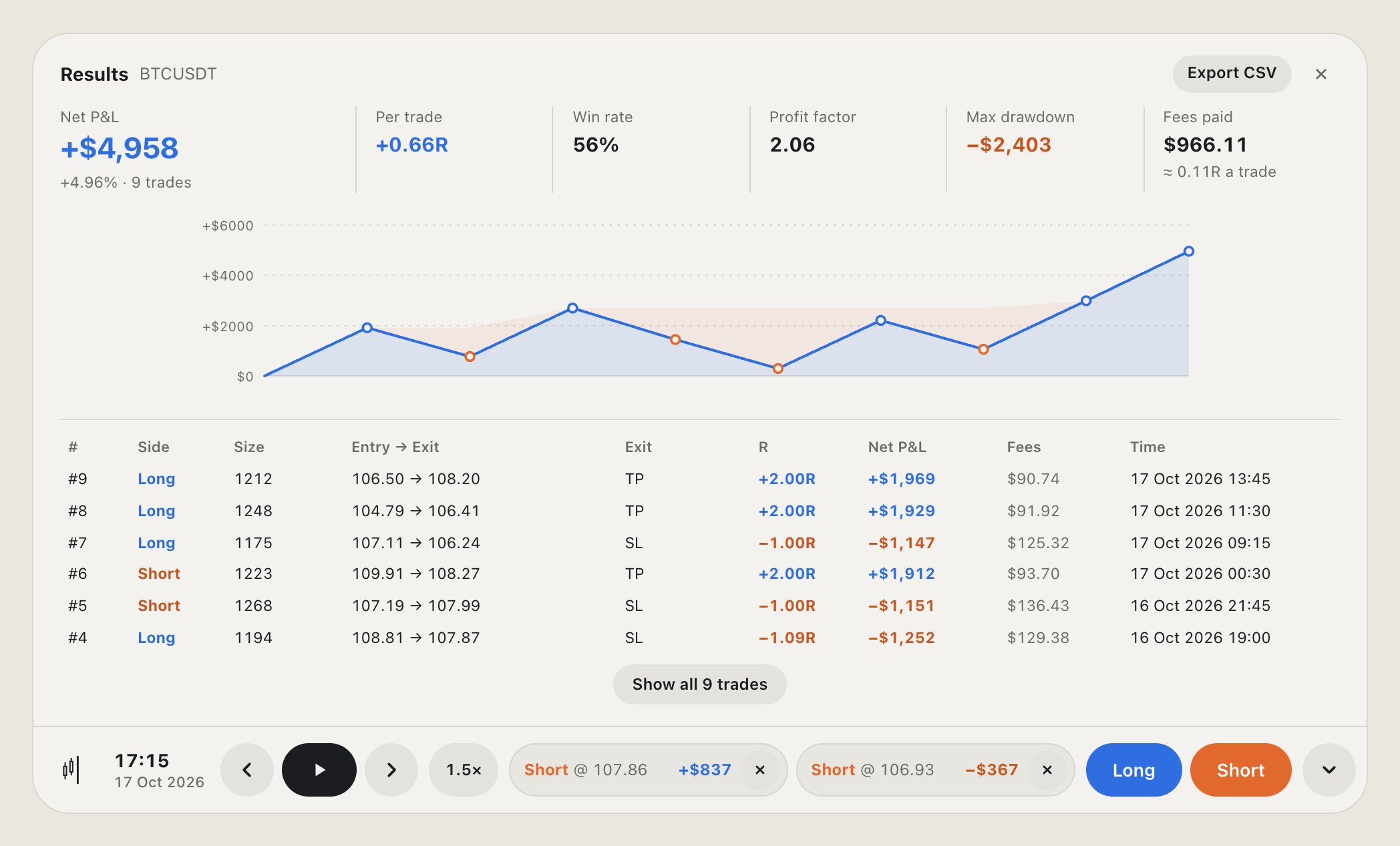
- Review in Backtest Lab. Open Backtest Lab to see results by hour, weekday, side, market and exit. Export the trades as CSV if you keep a spreadsheet.
What to record for each trade
Rechart records the mechanical part for you: date and time, side, size, entry and exit price, how the trade ended (target, stop or manual), result in R, net P&L and fees paid. Add the part only you know, in a note or spreadsheet next to the CSV:
- Which setup it was, if you test more than one.
- Whether you followed the rules exactly, or bent them.
- Market context: trend or range, news day, session.
- Trades you saw but skipped, and why. Skipped winners are information too.
Measure results in R, the multiple of what you risked, rather than in dollars. A +2R trade means the same thing on a $5,000 account and a $200,000 one, which makes sessions comparable.
Pitfalls that make a backtest lie
Look-ahead bias
Any glimpse of the future spoils a test. In Rechart, candles after the replay point are removed from the chart’s data, so zooming out, scrolling or switching timeframe can’t show them, and the forming candle of a higher timeframe is rebuilt from finer candles so its close isn’t visible early. The harder problem is memory: if you remember how March 2020 went, you will trade it differently. Random start dates help.
Ignoring fees
Fees look small per trade and large per year. At Binance’s regular futures rates, a $10,000 position entered at market and closed at a stop costs $10 in fees. With 1% risk on a $10,000 account, that is a tenth of your risk on every losing trade. A scalping strategy that earns 0.1R per trade before fees can easily be negative after them.
Too few trades
Twenty trades say very little. With 50 trades and a measured win rate of 50%, the true rate could plausibly be anywhere from about 36% to 64%. Keep going until the numbers stop moving, and treat a small sample as a reason to keep testing, not to go live.
Costs that aren’t simulated
Rechart doesn’t simulate spread, slippage or funding payments. Market orders fill at the candle’s price, and a gap through your stop fills at the next open. Expect live results to be somewhat worse than the replay, especially on short timeframes.
Changing the rules mid-test
If you adjust the rules after a losing streak, start a new session for the new version. Mixing two rule sets in one sample tells you about neither.
Where to backtest which market
- Crypto: your own exchange. OKX and Binance keep 1-minute history back to 2018 and 2019.
- Forex, gold and indices: a free TradeLocker demo account, sized in lots with per-lot commission.
- Stocks: stock perpetuals on BingX, Bybit or Binance, with months of history.
- A prop challenge: the prop challenge simulator, with daily loss and max loss checked on every candle.
For a side-by-side look at other tools, see the best free backtesting tools.
Questions
Where can I backtest for free?
For manual bar replay on intraday charts, Rechart is free on exchange and broker charts such as Binance, Bybit, OKX and TradeLocker. TradingView’s free plan replays daily charts. For coded strategies, the MetaTrader 5 strategy tester comes with the platform.
How many trades do I need in a backtest?
At least 50 per setup, and more is better. With 50 trades and a 50% win rate, the true win rate could still be anywhere from about 36% to 64%.
Is manual backtesting worth it?
Yes, if your trading involves judgement. It tests how you read the chart and follow your rules, which a coded tester can’t, and it builds screen time without risking money.
Does Rechart include trading fees?
Yes, if you switch them on. It charges the exchange’s own maker and taker rates, or a broker-style commission on TradeLocker. Spread, slippage and funding are not simulated.
Run your first free backtest tonight
Rechart is free in the Chrome Web Store and works in Chrome, Brave and Edge. No account, no subscription.