Practise a prop challenge for free
Rechart lets you practise a prop firm challenge for free on real past candles before you pay for a real one. Choose Classic 1-Step, Classic 2-Step or your own rules and an account from $5,000 to $200,000, and Rechart checks daily loss, max loss, profit target and trading days inside every candle, from Phase 1 through Phase 2 to Funded.
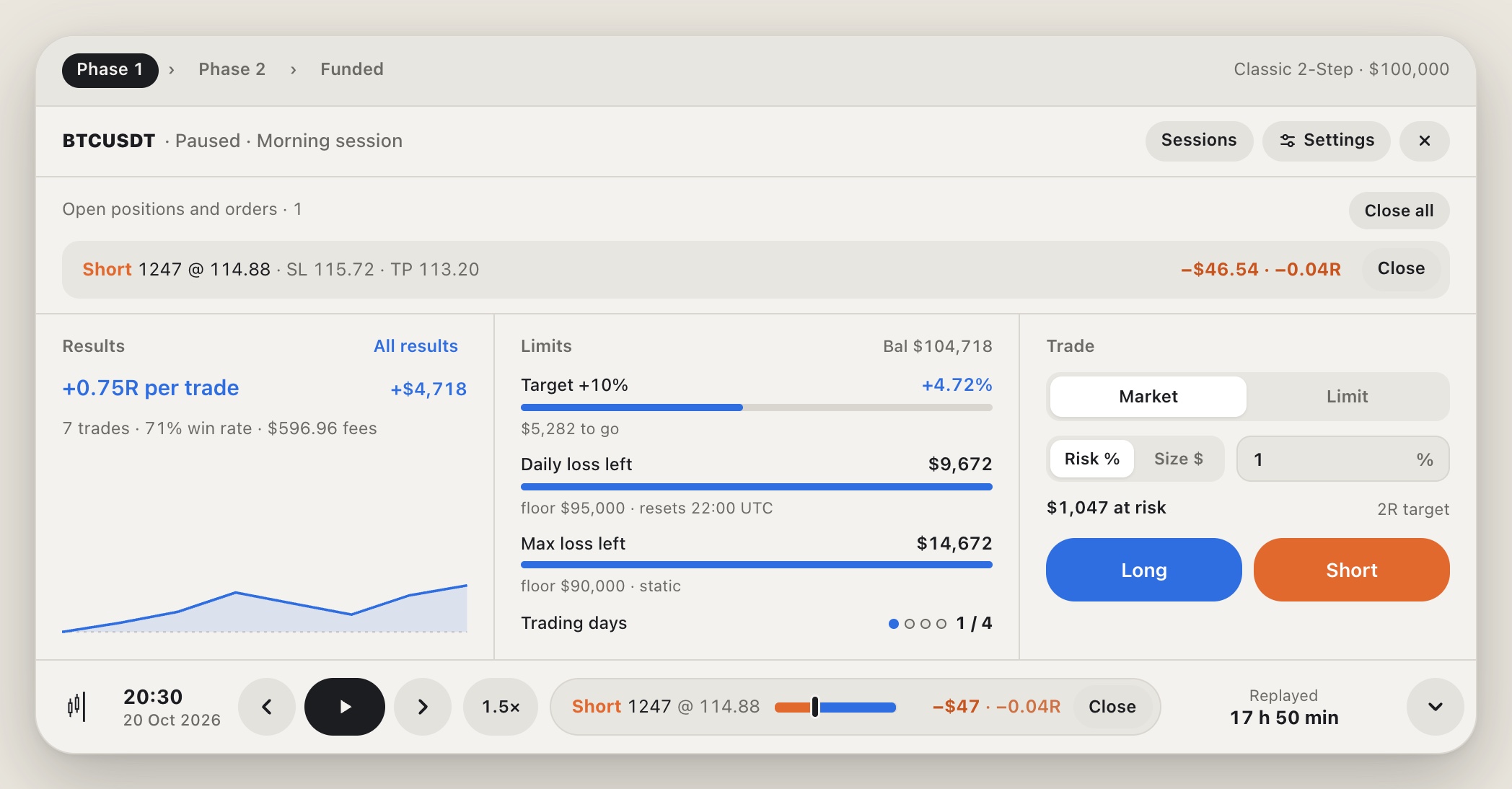
The three plans
| Classic 2-Step | Classic 1-Step | Custom | |
|---|---|---|---|
| Phases | Phase 1: +10%, at least 4 trading days. Phase 2: +5%, at least 4 trading days. Then Funded | Phase 1: +10%, no minimum days. Then Funded | Your Phase 1 target, an optional Phase 2 target, your minimum days |
| Daily loss | 5% of the initial size | 3% of the initial size | Your choice (5% by default) |
| Max loss | 10%, static | 10%, trailing the end-of-day balance | Your choice (10% by default), static or trailing |
| Best-day rule | None | Best day at most 50% of total profit | None |
| Day resets at | 00:00 Prague time | 00:00 Prague time | 00:00 UTC |
| Account sizes | $5,000, $10,000, $25,000, $50,000, $100,000 or $200,000 | ||
Prague midnight is 22:00 UTC in summer and 23:00 UTC in winter. A running challenge keeps the limits and targets it started with, so they never move mid-challenge.
How each limit is counted
Every limit is a fixed dollar amount, a percentage of the initial account size, never of the current balance.
- Daily loss: equity, meaning closed balance plus open profit and loss, may not fall below the balance at the day’s reset minus the daily amount. Profit made during the day doesn’t raise that floor.
- Static max loss: equity may not fall below the initial size minus the max loss.
- Trailing max loss (Classic 1-Step): the floor is the highest balance seen at a daily reset minus the max loss. It only moves up.
- Target: the closed balance must reach the target and the minimum trading days must be met. A trading day is a day with at least one trade.
- Best day (Classic 1-Step): not a breach. Once the target is reached, the phase passes when your best day is no more than half of the total closed profit.
- Leverage: margin is position value divided by leverage, and open margin can’t exceed equity. A trade that doesn’t fit is cut to the size that fits, or refused if less than 1% of it would.
Limits are checked inside every candle, not only at its close. Rechart works out your lowest equity anywhere within the candle, at its low, its high and every stop in between, so a wick that would have breached your daily loss fails the challenge, as it would at a real firm.
A worked example: $100,000 Classic 2-Step
| Daily loss amount | $5,000 |
|---|---|
| Max loss floor | Equity may not go below $90,000 |
| Phase 1 target | $110,000 closed balance, at least 4 trading days |
| Phase 2 target | $105,000 on a fresh $100,000 account, at least 4 trading days |
Say you start Wednesday with a balance of $103,000. Your daily floor for Wednesday is $98,000. If a winning trade takes you to $105,000 by noon, the floor stays at $98,000; if an open trade then drags your equity below $98,000, even for one wick, the challenge fails at that moment, however the candle closes.
Commission and leverage in the Classic plans
Prop firms charge their own commission rather than exchange fees, so in a challenge the plan’s commission replaces your exchange’s rates:
| Market | Commission per side | Leverage |
|---|---|---|
| Forex majors | $2.50 per lot | 1:100 |
| Metals | 0.0007% of volume | 1:50 |
| Oil and major indices | None, spread only | 1:50 |
| Stocks | 0.002% of volume | 1:3.33 |
| Crypto | 0.0325% of volume | 1:3.33 |
Run a challenge
- Open the chart you want to trade: a TradeLocker demo for forex and gold, or an exchange such as Binance or Bybit for crypto. Or start from Start a backtest.
- Click the Rechart icon and choose Prop challenge.
- Pick the plan and the account size. For Custom, set the targets, daily and max loss, minimum days, leverage and whether max loss trails.
- Click your start candle and trade. Daily and max loss left, target progress and trading days stay in view.
- Pass Phase 1 and the next phase starts on a fresh account; pending orders don’t carry over. Break a limit and the challenge ends, and Rechart shows which limit was hit.
There is no undo in a challenge. Stepping back is switched off once it starts, as it would be in real time.
How close is it to the real thing?
The Classic plans follow the structure of widely published challenge rules: daily loss from the day’s opening balance, static or end-of-day trailing max loss, phase targets, minimum days and per-market commissions and leverage. Spread and slippage aren’t simulated, so treat a pass as slightly optimistic. Rechart doesn’t name or represent any prop firm; check your firm’s own rules and set them in Custom if they differ.
To prepare well, run several challenges on different months rather than one, and look at your sessions together in Backtest Lab: which hours and setups pushed you towards the daily limit is often more useful than the pass itself. For general method, read how to backtest for free.
Questions
Is the prop challenge simulator free?
Yes. Prop challenge practice is part of Rechart, a free Chrome extension with no account and no subscription.
Which account sizes can I practise?
$5,000, $10,000, $25,000, $50,000, $100,000 and $200,000, on Classic 1-Step, Classic 2-Step or your own rules.
Is the daily loss checked on open trades?
Yes. Daily and max loss are checked on equity, including open profit and loss, at the worst point inside every candle.
Can I set my own firm’s rules?
Yes. Custom lets you set the Phase 1 and Phase 2 targets, daily loss, max loss, trailing or static, minimum trading days and leverage.
See whether you would pass, before you pay
Rechart is free in the Chrome Web Store and works in Chrome, Brave and Edge. No account, no subscription.